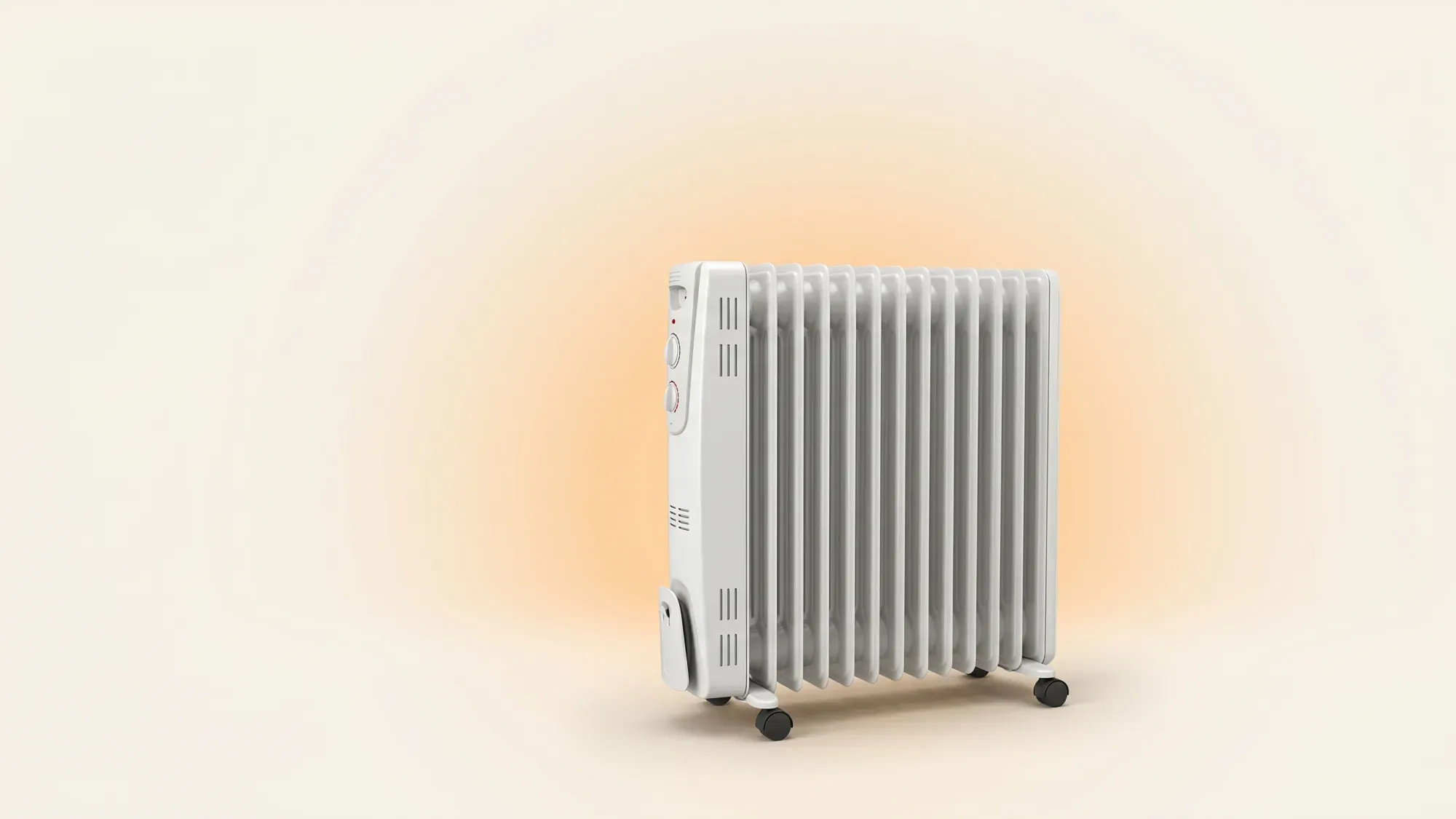
Understanding the running cost of an electric oil radiator is essential for managing your household budget, especially with fluctuating energy prices. From 1 July to 30 September 2026, the Ofgem Price Cap for electricity stands at 26.11p per kilowatt-hour (kWh) for those on a Standard Variable Tariff paying by Direct Debit. This figure is crucial for accurately calculating how much your oil radiator costs to run.
Managing your energy bills should be clear and easy to understand. Fuse Energy focuses on straightforward pricing, so you can see exactly what you're paying without unnecessary complexity. Click here to switch to Fuse Energy today.
What is an electric oil radiator?
An electric oil radiator is a plug-in heater that warms thermal oil sealed inside its fins. Electricity heats this oil, and the fins then radiate a steady, comfortable warmth into the room. Unlike fan heaters, oil radiators retain heat well, continuing to emit warmth even after they have stopped drawing power.
Why understanding costs matters now
With energy prices subject to change, knowing the true cost of running your appliances is more important than ever. Many residents struggle to accurately calculate and manage these costs, leading to financial uncertainty and potentially inefficient usage. Understanding how much your oil radiator adds to your electricity bill allows you to make informed decisions and optimise its use.
The basic cost calculation formula
Calculating the cost of running an electric oil radiator is straightforward. You need three pieces of information:
- The radiator's wattage (power consumption).
- The number of hours you use it.
- Your electricity unit rate.
The formula is: Wattage (kW) × Hours Used × Electricity Unit Rate (£/kWh) = Running Cost (£).
Finding your radiator's wattage
Your oil radiator's wattage is usually printed on a label on the appliance itself, often on the side or back. Electric oil radiators typically range from 500W to 2500W in power output. For calculations, convert watts (W) to kilowatts (kW) by dividing by 1,000 (e.g., 1500W becomes 1.5kW).
Identifying your electricity unit rate
Your electricity unit rate, measured in pence per kWh, is listed on your energy bill. If you have a smart meter, you might also be able to track this through your energy provider's app. As of 1 July 2026, the Ofgem Price Cap sets the electricity unit rate for standard variable tariffs at 26.11p per kWh.
Step-by-step cost calculation example
Let's calculate the daily cost of running an illustrative 1500W (1.5kW) oil radiator for 5 hours a day, using the current Ofgem Price Cap of 26.11p per kWh.
- Convert wattage to kW: 1500W ÷ 1000 = 1.5kW
- Calculate daily kWh consumption: 1.5kW × 5 hours = 7.5 kWh
- Calculate daily cost: 7.5 kWh × £0.2611/kWh = £1.96
So, an illustrative 1500W oil radiator used for 5 hours a day would cost approximately £1.96 per day. Over a month (30 days), this would be around £58.80.
Using a cost calculator for quick estimates
Many online tools can help you quickly estimate running costs. These calculators typically ask for your appliance's wattage and how many hours you plan to use it, then apply a default or user-inputted electricity rate to give you an instant estimate. While useful for quick checks, always verify the electricity rate used in the calculator against your actual tariff.
Radiator wattage and size
The wattage of your oil radiator is the primary determinant of its running cost. A higher wattage means more power consumed and, consequently, a higher cost per hour. Larger rooms or colder environments generally require higher wattage radiators to maintain comfortable temperatures.
Usage duration and frequency
The longer an oil radiator is switched on, the more electricity it will consume. However, oil radiators with thermostats do not run continuously at full power. Once the room reaches the desired temperature, the thermostat cycles the heating element on and off to maintain it, which can reduce overall energy consumption compared to continuous full-power operation.
Your electricity tariff and unit rate
The unit rate you pay for electricity has a direct impact on your running costs. Standard variable tariffs are subject to the Ofgem Price Cap, which changes quarterly. Fixed tariffs offer price certainty for a set period, while time-of-use tariffs (like Economy 7) have different rates for peak and off-peak hours, allowing for cheaper running if used strategically.
Room size and insulation levels
The size of the room and its insulation quality significantly affect how much heat is needed and how long the radiator must run. As a rule of thumb, a well-insulated room requires approximately 100W of heating power for every square metre of floor space. Poor insulation means more heat escapes, forcing the radiator to work harder and longer to maintain temperature.
Optimising placement for maximum heat distribution
Strategic placement can make a big difference. Position your oil radiator in the coldest part of the room, but avoid placing it directly under windows if there are draughts, as this can lead to heat loss. Ensure it is not obstructed by furniture or curtains, which can block heat circulation.
Using timers and thermostats effectively
Timers allow you to program your radiator to switch on and off at specific times, ensuring it only operates when needed. Thermostats help maintain a consistent temperature, preventing the room from overheating and the radiator from running unnecessarily. Setting the thermostat to a comfortable but not excessive temperature (e.g., 18-20°C) can save energy.
Improving home insulation and draught-proofing
Good insulation is key to retaining heat. Draught-proofing windows and doors, adding thicker curtains, or even considering loft and wall insulation can drastically reduce heat loss, meaning your oil radiator will not have to work as hard. The average UK home uses around 2,500 kWh of electricity per year, according to Ofgem's medium typical domestic consumption value effective from 1 July 20261, and improving insulation can help lower this figure.
Comparing with other heating options
While oil radiators are efficient at converting electricity to heat, it is worth considering how they fit into your overall heating strategy. For targeted heating of specific rooms, they can be a cost-effective choice. However, for heating an entire home, central heating (if available) or other electric options like storage heaters (which utilise cheaper off-peak electricity) might be more suitable.
Efficiency compared to other electric heaters
All electric heaters, including oil radiators, are nearly 100% efficient at converting the electricity they consume into heat. The "efficiency" difference often comes down to how effectively they distribute and retain that heat. Oil radiators excel at heat retention due to the thermal oil, which continues to radiate warmth even after the power is off. This makes them effective for sustained, gentle heating.
When an oil radiator is a cost-effective choice
Oil radiators are particularly cost-effective for:
- Targeted heating: Warming a single room or zone rather than the entire house.
- Supplementary heat: Boosting warmth in a room that central heating struggles to reach.
- Infrequent use: When you only need heat for a few hours a day or in specific situations.
- Maintaining temperature: Their heat retention properties make them good for keeping a steady warmth without constant power draw.
Long-term considerations for home heating
For long-term home heating, consider your property's overall energy efficiency, often indicated by an Energy Performance Certificate (EPC). Improving insulation, upgrading to more efficient windows, or exploring heat pumps can reduce your reliance on electric resistance heating, which, while nearly 100% efficient at the point of use, can be more expensive per kWh than gas.
Fuse Energy can help you track your overall electricity usage through its transparent app, empowering you to see the impact of your oil radiator's consumption on your bill. By providing clear cost calculations and efficiency tips, Fuse helps customers use their oil radiators effectively without fear of excessive bills. Fuse's commitment to data-backed insights extends to helping customers understand appliance costs, providing rigorous, UK-specific calculations. Customers with questions about their energy usage or tariffs can contact Fuse's 24/7 human customer support for assistance, helping them manage their oil radiator costs. Switching to Fuse is quick and easy, taking just a few minutes online. Click here to switch to Fuse Energy today.