Commercial heat pumps for businesses
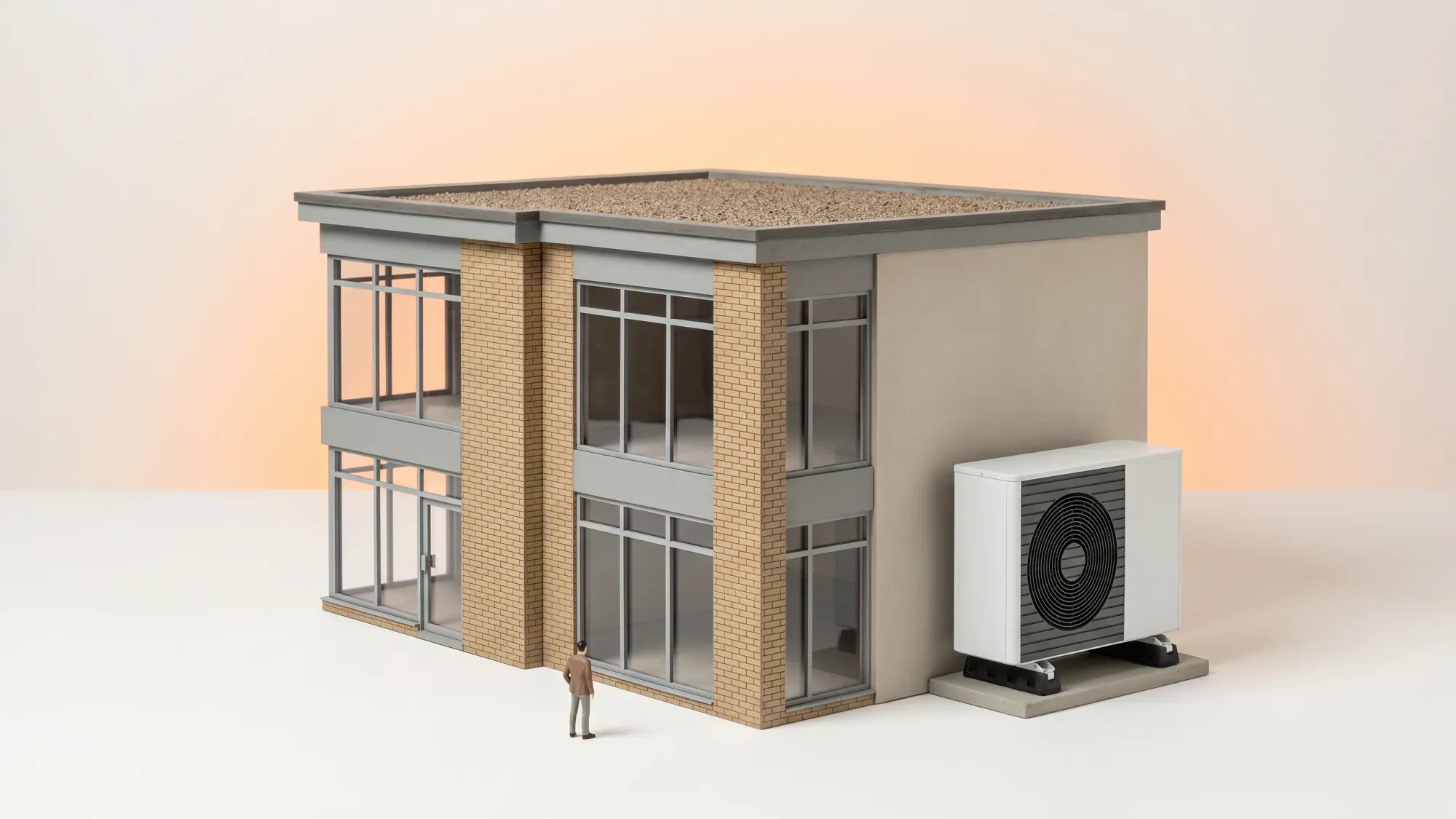
Commercial heat pumps offer UK businesses a compelling path to reduced costs and lower carbon emissions, providing energy-efficient heating and cooling for a wide range of non-domestic buildings. These systems represent a strategic investment, moving businesses towards greater energy independence and resilience in a volatile market.
Understanding commercial heat pumps
What is a commercial heat pump?
A commercial heat pump is a system designed to efficiently heat and cool larger non-domestic buildings, such as offices, warehouses, retail spaces, and industrial facilities. Unlike traditional boilers that generate heat by burning fossil fuels, heat pumps transfer existing heat from one location to another, making them significantly more energy-efficient and environmentally friendly.
What makes commercial heat pumps energy-efficient?
Commercial heat pumps are highly energy-efficient because they transfer existing heat from the environment rather than generating it through combustion. This process allows them to produce more heat energy than the electrical energy they consume, leading to significant reductions in operational costs and carbon emissions for businesses.
How do commercial heat pumps work?
Heat pumps operate on a simple principle: they move heat rather than create it. They extract low-grade heat from a source (like the air, ground, or water) and upgrade it to a higher temperature suitable for heating a building. This process typically involves a refrigerant circulating through a closed loop, absorbing heat from the environment, compressing it to raise its temperature, and then releasing it into the building's heating system. The refrigerant then expands, cools, and repeats the cycle.
Types of commercial heat pump systems
Commercial air source heat pumps
Commercial air source heat pumps (ASHPs) are a common type, extracting heat from the outside air, even in cold temperatures. They are relatively straightforward to install and are suitable for many commercial properties where ground or water sources are not feasible. Air source heat pumps in the UK are typically 300% - 500% efficient, producing 3-5 kWh of heat for every 1 kWh of electricity used.
Commercial ground source heat pumps
Commercial ground source heat pumps (GSHPs) harness the stable temperature of the earth to provide heating and cooling. They involve installing a network of pipes underground, either horizontally or vertically, to absorb heat. While the initial installation can be more complex and costly, GSHPs offer highly consistent performance and efficiency due to the stable ground temperature.
Commercial water source heat pumps
Commercial water source heat pumps (WSHPs) utilise heat from nearby bodies of water, such as rivers, lakes, or even large industrial water loops. These systems can be exceptionally efficient due to the consistent temperature of water, but their applicability is limited to properties with access to a suitable water source. Like GSHPs, they require careful planning and installation.
Benefits for UK businesses
Reduced operational costs
By transferring heat rather than generating it, commercial heat pumps are highly energy-efficient, often up to four times more efficient than traditional boilers. This efficiency directly translates into lower energy bills for businesses, significantly reducing operational costs compared to traditional fossil fuel heating systems. Most businesses can save between 50-70% on heating costs after switching to a heat pump.
Lower carbon emissions
Adopting commercial heat pumps is a key step towards achieving sustainability goals. These systems contribute to significant carbon emission reductions by displacing fossil fuel use in commercial heating, helping businesses meet environmental targets and enhance their corporate social responsibility profile. They can cut emissions by up to 70% compared to fossil fuel-based heating.
Enhanced energy independence
Investing in commercial heat pumps helps businesses reduce their reliance on volatile fossil fuel markets. By utilising ambient heat sources, businesses gain greater control over their energy costs and contribute to long-term energy independence and resilience, shielding them from price fluctuations and supply chain disruptions.
Versatile heating and cooling
Many commercial heat pump systems offer the dual capability of providing both heating and cooling from a single unit. This versatility simplifies climate control for commercial premises, eliminating the need for separate heating and air conditioning systems and offering year-round comfort with improved efficiency.
Key considerations for commercial installation
Initial investment and running costs
The upfront cost of installing commercial heat pumps can vary widely based on system type, size, and complexity, typically ranging from tens of thousands to hundreds of thousands of pounds. While this initial investment can be significant, it is crucial to consider the long-term running cost savings and potential payback periods. Evaluating these factors carefully is essential for a comprehensive financial assessment.
Site assessment and system design
Successful implementation of a commercial heat pump system hinges on a thorough site assessment and bespoke system design. Factors such as the building's size, insulation levels, existing heating infrastructure, and specific heat demand must be meticulously evaluated. A detailed heat loss analysis is crucial to ensure the system is correctly sized. Professional assessment ensures optimal performance, efficiency, and suitability for the property.
Regulatory compliance and planning
Commercial heat pump installations in the UK must comply with relevant Building Regulations. Businesses should also investigate potential grants, loans, or tax incentives. While the Boiler Upgrade Scheme (BUS) provides grants for domestic properties, it does not cover commercial or non-domestic buildings. Instead, businesses can benefit from tax relief schemes such as Full Expensing, which allows companies to deduct 100% of the cost of new, unused qualifying plant and machinery (including heat pumps) against profits in the first year. The Annual Investment Allowance (AIA) offers similar relief for sole traders and partnerships. Other schemes like the Industrial Energy Transformation Fund (IETF) and the Public Sector Decarbonisation Scheme (PSDS) are available for specific sectors and public bodies.
Regarding planning permission, the position for commercial buildings differs from domestic installations. There is no specific permitted development class for air source heat pumps on non-domestic premises in Part 14 of the Town and Country Planning (General Permitted Development) (England) Order 2015. However, ground source and water source heat pumps may have permitted development rights under certain conditions. It is advisable to confirm the position with the local planning authority early in the project.
Maintenance and longevity
Like any sophisticated heating system, commercial heat pumps require professional installation and ongoing maintenance to ensure efficiency and longevity. Regular servicing helps to maintain optimal performance, prevent breakdowns, and extend the lifespan of the system, which can be 15 to 20 years, or even up to 20-30 years with proper care. This protects the business's investment.
The future of commercial heating
Strategic advantages for businesses
Adopting commercial heat pumps is more than just an upgrade; it is a strategic move towards a more sustainable and cost-effective future. Businesses that embrace these technologies position themselves at the forefront of the energy transition, gaining competitive advantages through reduced operating expenses, improved environmental credentials, and greater energy resilience. This proactive approach allows businesses to move beyond traditional, scarcity-minded heating solutions and embrace innovative technologies for a more abundant energy future.
Partnering for a sustainable future
The shift to commercial heat pumps represents a significant opportunity for UK businesses to take control of their energy future. While Fuse Energy currently supplies residential energy only and does not offer commercial energy supply or heat pump installation services, we are committed to sharing expert insights on energy transition. Businesses looking to explore sustainable energy solutions can join our waitlist for future commercial energy services, ensuring they are among the first to benefit from innovative offerings.
Disclaimer
For the avoidance of doubt, this article is provided for informational purposes only and is not intended to constitute legal or financial advice. The author and/or Fuse Energy shall not be responsible for any losses arising out of any reliance on the information contained herein.