Commercial solar panels for businesses
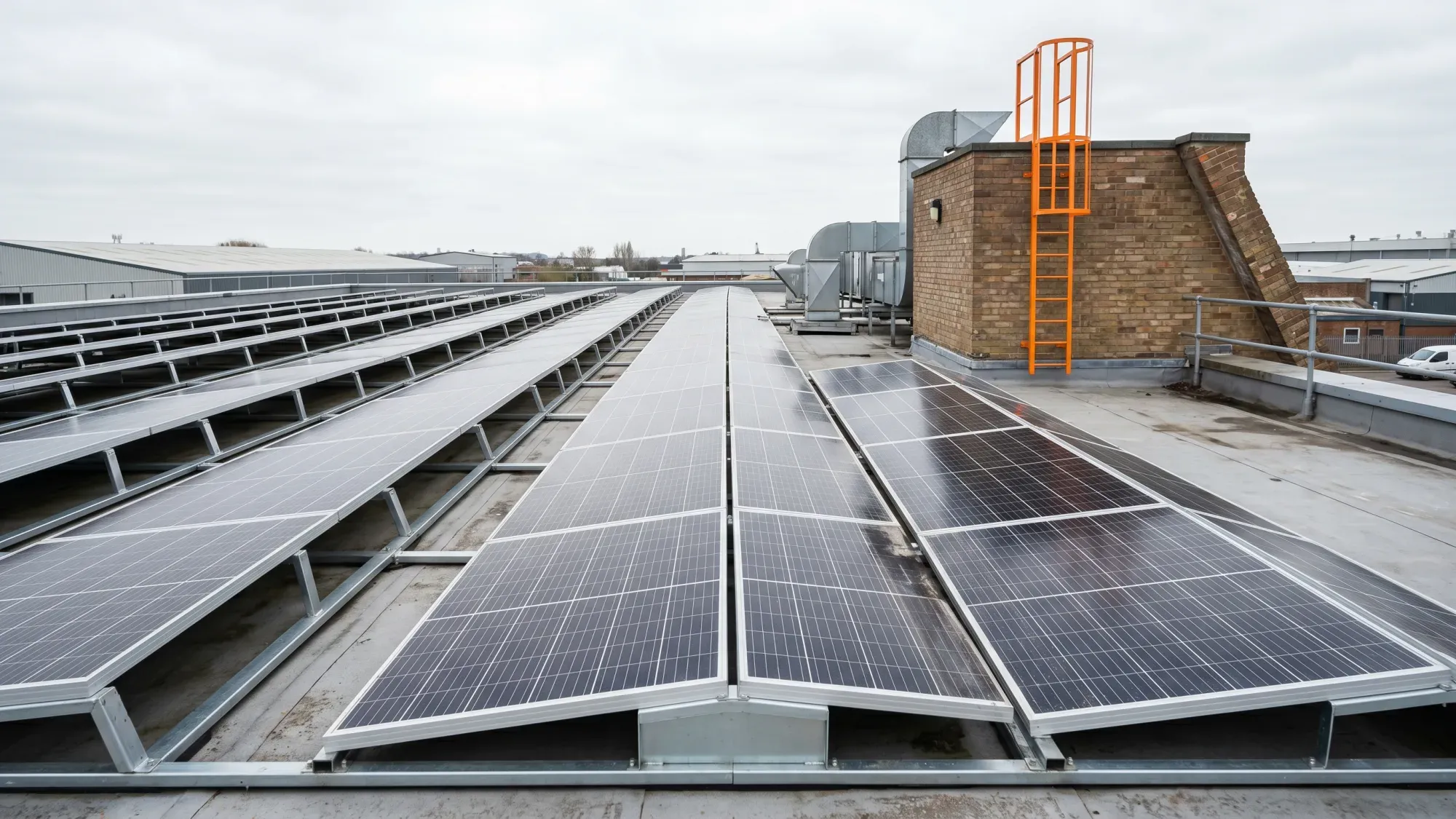
Investing in commercial solar panels offers UK businesses a clear path to reducing operational costs and enhancing sustainability. This guide outlines the benefits, practical considerations, and financial incentives available for installing solar photovoltaic (PV) systems on commercial premises.
Why consider business solar panels for your operations?
Businesses across the UK are increasingly turning to solar energy to secure their energy future. Generating your own electricity can bring significant advantages, from direct cost savings to improved environmental standing.
Reducing operational costs
One of the most compelling reasons for businesses to install solar panels is the potential for substantial long-term cost savings. By generating your own electricity, you reduce reliance on grid power, directly lowering your energy bills. Any surplus energy generated can also be exported back to the grid, providing an additional revenue stream through schemes like the Smart Export Guarantee (SEG).
Enhancing energy independence
Generating your own power provides greater control over your energy supply, insulating your business from volatile energy prices and potential grid disruptions. This increased energy independence contributes to business resilience, ensuring more stable operating costs and a reliable power source.
Boosting your green credentials
Adopting solar energy demonstrates a clear commitment to environmental responsibility. This not only helps meet corporate sustainability goals but also resonates with eco-conscious customers, investors, and stakeholders, enhancing your brand reputation and market appeal.
Long-term investment and asset value
Commercial solar panel systems in the UK typically offer a payback period of 4-8 years, with a lifespan often exceeding 25 years. This makes them a robust long-term investment that adds significant value to your property and provides decades of reduced energy expenses.
Understanding commercial solar panel systems
Commercial solar PV systems are designed to harness sunlight and convert it into usable electricity for your business operations.
How commercial solar PV works
Solar panels, typically made of photovoltaic (PV) cells, absorb sunlight and convert it into direct current (DC) electricity. An inverter then converts this DC electricity into alternating current (AC), which is the standard electricity used in commercial buildings. This AC power can either be used directly by your business, stored in batteries, or exported to the National Grid.
Types of solar panels for businesses
While the fundamental technology is similar to residential systems, commercial installations often utilise larger, more efficient panels designed for industrial scale. Monocrystalline panels are often top performers, boasting efficiency rates between 16% and 22%. Polycrystalline panels offer slightly lower efficiency, usually between 15% and 18%. Thin-film panels may also be used in specific applications where flexibility or aesthetics are a priority, though they are less efficient.
Key components of a commercial system
A typical commercial solar PV system includes:
- Solar panels: The modules that convert sunlight into electricity.
- Inverters: Convert DC power from the panels into AC power for your building.
- Mounting system: Securely fixes the panels to your roof or ground.
- Cabling and wiring: Connects all components and integrates with your building's electrical system.
- Monitoring system: Tracks energy generation and consumption, allowing you to optimise performance.
- Optional battery storage: Stores excess electricity for use during periods of low generation or high demand.
The commercial solar panel installation process
Installing a commercial solar system involves several stages, from initial assessment to ongoing maintenance.
Initial assessment and design
The first step is a comprehensive assessment of your business's energy consumption patterns and the suitability of your site for solar. This includes evaluating roof space, structural integrity, shading, and your current electricity usage. Based on this, a bespoke system design is created to maximise energy generation and cost savings.
Planning permission and grid connection
Most commercial rooftop solar installations in the UK do not require full planning permission due to permitted development rights. However, certain conditions apply, such as panels not protruding more than 200mm from the roof surface and being at least 1 metre from the roof edge. Full planning permission is typically required for installations on listed buildings, within conservation areas (especially if visible from a public road), or on scheduled monuments. Ground-mounted systems also usually require planning permission if they exceed 9m² or stand higher than 4 metres.
Alongside planning, you will need approval from your Distribution Network Operator (DNO) for grid connection, particularly for larger systems that will export significant amounts of electricity. DNOs own and operate the local electricity distribution networks. For systems up to 3.68kW per phase, a G98 notification is typically used, while larger systems often require a G99 application, which must be approved before installation.
Installation and commissioning
Once approvals are in place, Microgeneration Certification Scheme (MCS)-certified installers will proceed with the physical installation of the panels and associated equipment. After installation, the system is commissioned, tested, and connected to the grid.
Maintenance and monitoring
While solar PV systems are generally low-maintenance, regular monitoring ensures optimal performance. This involves checking energy generation data and conducting periodic inspections and cleaning to keep the panels efficient.
Financial incentives and funding for business solar
The UK government offers various incentives to encourage businesses to adopt renewable energy.
Smart Export Guarantee (SEG)
The SEG mandates licensed electricity suppliers to offer payments for electricity exported to the grid from eligible renewable installations. This provides a valuable income stream for businesses that generate more electricity than they consume. To qualify, your installation typically needs to be certified under the MCS and have a smart meter capable of half-hourly readings.
Capital allowances and tax benefits
Businesses can often benefit from capital allowances, such as the Annual Investment Allowance (AIA), which allows them to deduct 100% of the qualifying capital expenditure on solar panels from their taxable profits in the year of purchase, up to an annual limit of £1 million. If the AIA limit is exceeded, the First Year Allowance (FYA) may allow a 50% deduction in the first year for certain expenditure incurred before April 2026. These deductions can significantly reduce the upfront cost burden and accelerate the payback period.
Financing options for commercial PV
Several financing options are available for businesses considering solar, including:
- Outright purchase: Paying for the system upfront, offering the highest long-term savings.
- Commercial loans: Specialised loans for renewable energy projects.
- Power purchase agreements (PPAs): A third-party owns and maintains the system on your premises, and you buy the electricity generated at a fixed, often lower, rate.
- Leasing: Similar to PPAs, but you lease the equipment and may have an option to buy it later.
Calculating your return on investment
Calculating the return on investment (ROI) for a commercial solar system involves assessing the initial investment against projected savings on electricity bills, income from SEG payments, and any tax benefits. Most UK commercial solar installations recover their upfront cost within roughly 4 to 8 years.
Key considerations for UK businesses
Before committing to a commercial solar installation, several factors require careful consideration.
Roof suitability and structural integrity
A thorough assessment of your building's roof is crucial. This includes checking its size, orientation, shading, and structural capacity to support the weight of the solar panels. Not all roofs are suitable, and structural reinforcements may be necessary in some cases.
Choosing an MCS-certified installer
Selecting a reputable and accredited installer is paramount. Ensure your chosen installer is certified under the MCS. This guarantees that the installation meets high industry standards and is a requirement for accessing certain incentives like the SEG.
Insurance and warranties
Ensure your business insurance policy covers the solar PV system. Additionally, understand the warranties provided for the panels, inverter, and installation work. Panels typically come with a performance warranty of 25 years or more.
Integrating with other energy solutions
Consider how solar panels can integrate with other energy solutions, such as battery storage systems for optimising self-consumption, or electric vehicle (EV) charging infrastructure. This holistic approach can further enhance energy independence and cost savings.
The future of business energy: abundance and opportunity
The shift towards renewable energy sources like solar PV is transforming the energy landscape, moving away from a scarcity mindset towards one of abundance.
Embracing energy independence
For businesses, this means the opportunity to take control of their energy future. By generating your own power, you're not just cutting costs; you're building resilience and contributing to a more sustainable, independent energy system. This aligns with a vision where energy is so abundant it stops being a constant concern, allowing businesses to thrive and innovate without the burden of unpredictable energy costs.
Fuse Energy's vision for commercial power
Fuse Energy is committed to building a future with abundant, clean energy. We believe in challenging the scarcity mindset in energy. We are actively working towards future commercial energy solutions.
Conclusion
Commercial solar panels offer a compelling proposition for UK businesses seeking to reduce operational costs, enhance energy independence, and improve their environmental credentials. With supportive government incentives and a clear path to long-term savings, now is an opportune time for businesses to explore the benefits of solar PV.
Disclaimer
For the avoidance of doubt, this article is provided for informational purposes only and is not intended to constitute legal or financial advice. The author and/or Fuse Energy shall not be responsible for any losses arising out of any reliance on the information contained herein.